
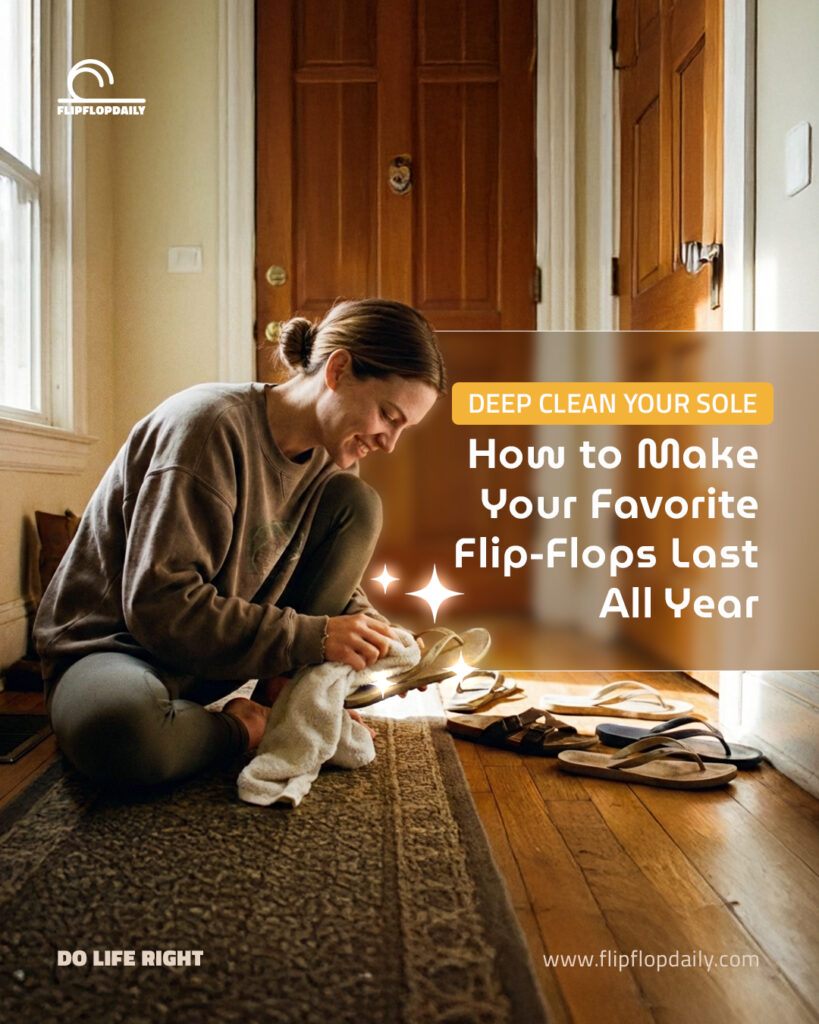
Let’s be honest: Deep Clean Your Sole—there is a specific kind of heartbreak that only happens when your favorite pair of flip-flops finally gives up the ghost. Whether it’s a mid-walk blowout or a smell that could peel paint, we’ve all been there.
We often treat flip-flops as disposable, but in a world leaning toward sustainability—and let’s face it, wanting to keep that perfect “broken-in” feel—treating your footwear with a little scientific respect goes a long way. This isn’t just about cleaning; it’s about Footwear Stewardship.
Here is how you can optimize the life-cycle of your soles, from the molecular level to the “bread-tag” emergency fix.
1. Know Your Chemistry: Rubber vs. EVA
Not all flip-flops are created equal. If you treat leather like rubber, you’re going to have a bad time.
- Natural Rubber: Tough and bouncy, but its kryptonite is the sun. Direct UV rays break down polymer chains, making them brittle due to polymer degradation from UV exposure. If you leave your rubber Havaianas flip-flops on a scorching balcony, they will shrink or crack.
- EVA Foam (Ethylene-Vinyl Acetate): This is the “squish” factor we love. However, EVA foam is microscopically porous. It’s basically a sponge for sweat and skin cells. This is where the “funk” lives.
- Croslite (Crocs): A closed-cell resin. Unlike EVA, it doesn’t absorb as much moisture, which is why they’re the king of low-maintenance.
Material Cheat Sheet
| Material | The “Big Bad” | Failure Mode |
| Rubber | UV Radiation | Cracking & Brittleness |
| EVA Foam | Compression | Flattening (Loss of “squish”) |
| Leather | Water/Dry Air | Surface Fissures (Cracks) |
| Canvas | Humidity | Fungal Growth (Mildew) |
2. The Microbiology of “The Funk”
Why do flip-flops smell like a locker room after a month? It’s a biological cocktail. Your feet have more sweat glands per square inch than almost anywhere else. Bacteria like Staphylococcus eat your sweat and skin oils, exhaling volatile organic compounds (VOCs).
To stop the smell, you have to kill the colony.
- The Vinegar Soak: White vinegar is a “stink assassin.” Its acidity creates an environment where bacteria simply cannot survive.
- Baking Soda (Sodium Bicarbonate): This is your best friend for physical scrubbing. It’s a mild abrasive that neutralizes acidic odors.
- The “Sunlight” Double-Edge: While UV kills bacteria (great!), too much heat ruins the material (bad!). Aim for 30 minutes of direct sun for sanitization, then move them to the shade.
3. The “Deep Clean” Protocol
If your pairs have reached “biohazard” status, a quick rinse won’t cut it. You need a systematic approach.
- The Immersion: Soak in warm (never hot) water with a splash of dish soap and borax for at least two hours.
- The Detail Work: Grab an old toothbrush. Focus on the “tread” and the areas where the straps meet the base. This is where sand and sweat hide.
- The Scuff Hack: If your soles have become dangerously slippery, use 50-grit sandpaper to lightly scuff the bottom. This restores the grip and removes the top layer of compacted grime.
A Note on Machine Washing: Only do this for canvas or basic rubber pairs. Use cold water and toss in some old towels to act as a muffler. Never put flip-flops in the dryer; the heat will melt the adhesives and warp the shape.
4. Emergency Engineering: The Survival Guide
A broken strap doesn’t have to mean a trip to the trash can. If you’re out and about and a strap pulls through, use these “MacGyver” fixes:
- The Bread Tag Fix: Slide a plastic bread tag around the “plug” on the bottom of the shoe. It creates a wider base so the strap won’t pull through the hole.
- The Zip Tie Loop: If a strap snaps entirely, a heavy-duty zip tie can create a temporary (albeit industrial-looking) replacement.
- Puff Paint for Traction: If the bottoms are slick, draw a “tread” pattern with 3D puff paint. Once dry, it provides a rubberized grip.
5. Managing Your Gear in 2026: The Digital Landscape
If you’re a brand or a creator in the footwear space, the game has changed. By 2026, Google and AI search tools look for Human-Centric Authority.
- Visual Search is King: People are using tools like Google Lens to identify shoe models and fix-it tutorials. High-res, “real-world” photos are better than stock images.
- Entity Clarity: Don’t just talk about “shoes.” Talk about “arch support for plantar fasciitis” or “closed-cell resin durability.” Specificity is the antidote to AI-generated noise.
The Flip-Flop Life
At the end of the day, flip-flops represent a choice. They represent relaxation, community, and a refusal to be “bottled up” in wingtips or heels. By taking care of your footwear, you’re practicing a small form of mindfulness and sustainability.
Don’t just wear your shoes until they die; be their steward. Your feet (and the planet) will thank you.
It’s time to Do Life Right!
Check out the best flip flop reviews, flip flop advice and flip flop philosophy on how to live a flip flop life!