
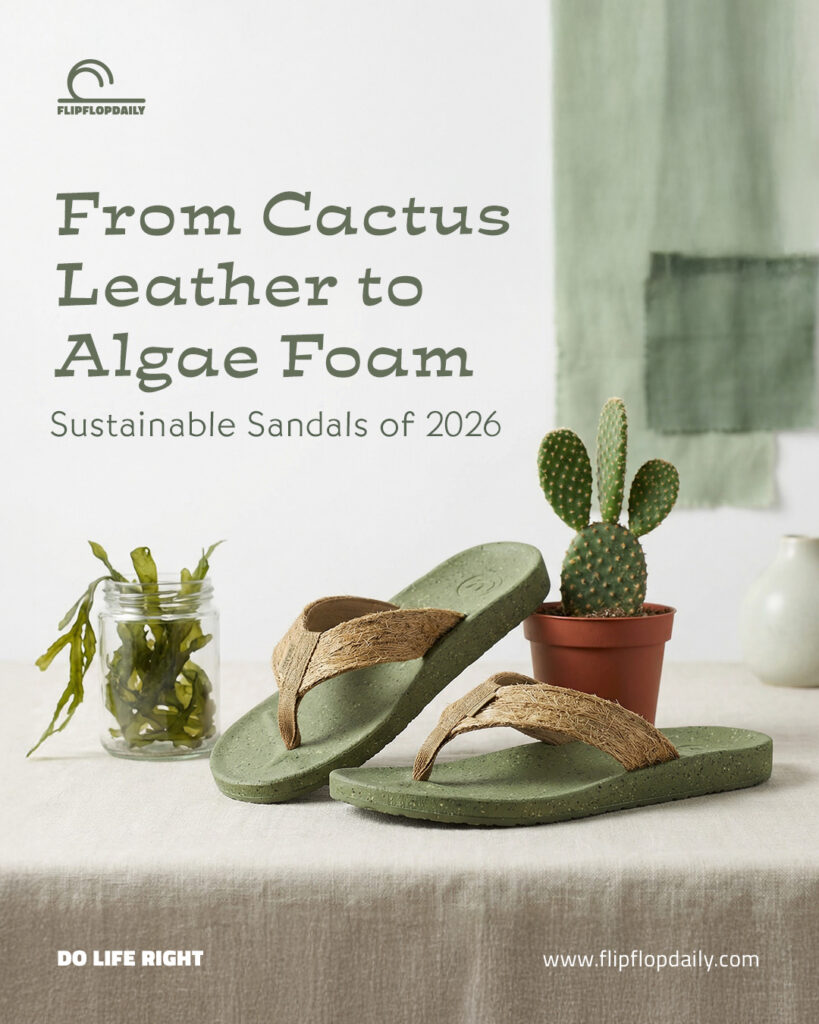
From Cactus Leather to Algae Foam: The Sustainable Sandals of 2026
The “flip-flop life” used to come with a side of environmental guilt. For decades, the global footwear industry was a heavy hitter in the pollution category—pumping roughly 700 million metric tons of greenhouse gases a year. According to the World Economic Forum, fashion accounts for an estimated 2–8% of global emissions, placing footwear squarely in the sustainability spotlight. And our favorite beach staple? Often the worst offender. Most flip-flops were basically petroleum-based foam sandwiches made from materials like EVA and PVC—both derived from fossil fuels and difficult to recycle.
But 2026 feels different. Welcome to the “Flip Flop Revolution.” We’ve moved past the era of niche eco-boutiques. Thanks to advances in biomaterials, growing interest in circular design (see the Ellen MacArthur Foundation), and new regulations like the EU’s Digital Product Passport initiative under the Ecodesign for Sustainable Products Regulation, your summer sandals are more likely to come from a lab or a cactus farm than an oil rig.
Here is the guide to treading lightly (and stylishly) this year.
The New Math of Sustainability
In the old days, “eco-friendly” just meant using a little less plastic. Today, it’s about regenerative design. We’re seeing carbon-negative materials that actually breathe in more $CO_2$ while they grow than they emit during manufacturing. Check out how the stats have shifted:
| Key Sustainability Metric | Traditional Sandal (Pre-2020) | Sustainable Sandal (2026) |
| Primary Material | Petroleum-based EVA / PVC | Bio-based Foam / Plant Leather |
| Carbon Footprint (Avg) | 14.0 kg $CO_2e$ | 0.0 to 2.5 kg $CO_2e$ |
| End-of-Life | Landfill / non-biodegradable | Recyclable / Compostable |
| Water Impact | High chemical runoff | Minimal use / Water filtration |
Cactus Leather: The “Buttery” Hero of 2026
If you haven’t felt cactus leather (specifically the stuff from Desserto), you’re in for a treat. It’s supple, durable, and—best of all—doesn’t involve industrial cattle ranching.
The Nopal (Prickly Pear) cactus is basically a sustainability overachiever. It uses Crassulacean Acid Metabolism (CAM), a cool trick where it “breathes” in $CO_2$ at night to save water. While most plants need 1,000 liters of water to make a kilogram of dry matter, the Nopal only needs about 200.
Fun Fact: Cactus leather saves about $1,864\%$ of carbon-equivalent emissions compared to animal leather. Plus, farmers only harvest the mature leaves, so the plant stays alive and keeps scrubbing the air for years.
Brands like Reef and AVAR Earth have gone all-in on this for 2026. Their “Eco-Sophisticate” lines are water-resistant and actually mold to your feet over time. Unlike old-school leather that cracks after one salty beach day, this stuff holds its own.
Algae Foam: Cleaning the Water While You Walk
If the straps are cactus, the “squish” is likely algae. Technology from companies like BLOOM is turning a major problem (toxic algae blooms caused by agricultural runoff) into a solution. They harvest the excess algae, filter the water, and return it to the ecosystem cleaner than they found it. That biomass then gets turned into high-performance foam.
Sanuk Grateful Dead™ Collection: Uses BLOOM™ foam to clean roughly $2,800\text{ m}^3$ of air per pair.
Hunter Bloom Sandals: These offer the same arch support and “bounce” as traditional EVA but with a fraction of the fossil fuel reliance.
The Fungal Future: Mycelium Luxury
“Mushroom leather” has officially hit the boardwalk. Mycelium—the root system of fungi—can be grown in trays in just two to three weeks. It’s grown on agricultural waste (like sawdust or hemp hulls), making it a circularity dream.
Reef’s 2026 “Mushroom Collection” features a soft, suede-like texture in sophisticated earth tones like Leaf Green and Granite Grey. It’s breathable, naturally antimicrobial, and feels like a luxury upgrade from the plastic slabs of the past.
Cleaning Up the Past: Tires and Sugarcane
Sustainability in 2026 isn’t just about new plants; it’s about cleaning up our old messes.
Indosole: These guys are legends for taking discarded tires—a literal nightmare for landfills—and grinding them into 100% recycled outsoles. Their “ESSNTLS” line is designed to last 1,000 miles. It’s the ultimate “buy once, wear forever” sandals.
The Sugarcane Shift: Brands like Allbirds are using sugarcane-derived “SweetFoam.” Since sugarcane captures $CO_2$ as it grows, the material is carbon neutral. Their M0.0NSHOT Zero sandals are the first to hit that elusive $0.0\text{kg} CO_2e$ mark.
Caring for Your Investment
The most sustainable sandal is the one you don’t have to replace next year. Here’s the 2026 cheat sheet for maintenance:
Cactus/Pineapple Leather: Dab on a bit of natural wax every few months. It keeps the “leather” supple and the water-resistance high.
Hemp & Recycled Straps: Hand-wash with mild, eco-friendly soap. Avoid the dryer!
Cork & Rubber: Don’t leave them in the baking sun for three days straight. High heat can make natural rubber brittle.
Final Thoughts
In 2026, “doing life right” means recognizing that every step matters. By choosing sandals made from cactus, algae, or recycled tires, you’re casting a vote for a cleaner ocean and a healthier planet. And let’s be honest—they look way better than those $5 plastic foam ones anyway.
It’s time to Do Life Right!
Check out the best flip flop reviews, flip flop advice and flip flop philosophy on how to live a flip flop life!