
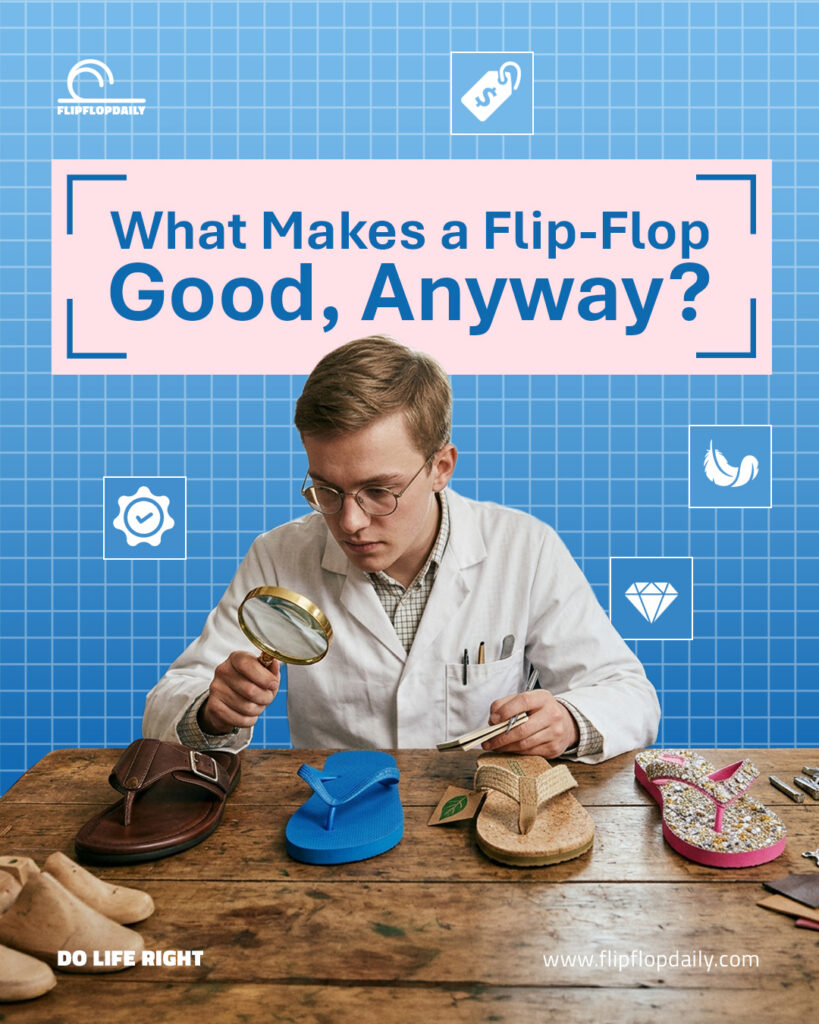
When most of us think about flip-flops, we picture those flimsy, five-dollar foam slabs you grab at a drug store when you forget your real shoes. They have a flat bottom, a rubber Y-strap, and a lifespan of about three weeks. But believe it or not, the modern flip-flop has quietly become secretly complicated. There is a massive gap between disposable beachwear and a sandal you can actually live in without wrecking your body.
So, what actually makes a flip-flop good?
First off, let’s talk about the squish factor. Budget sandals are stamped out of cheap, single-density foam. Yeah, they feel amazingly soft when you try them on. But that material suffers from what engineers call a high “compression set.” Basically, after a few days of carrying your body weight, the foam permanently flattens out. You’re left walking on a hard pancake.
The good stuff uses dual-density foam or natural cork. Cork is honestly kind of magic for footwear. It breathes, it fights off foot sweat, and over time, your body heat actually forces it to mold to your specific footprint. Better yet, the smartest brands are ditching petroleum plastics entirely. They’re making carbon-negative foams out of harvested algae blooms and Brazilian sugarcane. You get that bouncy, shock-absorbing feel, and the planet gets a break.
But the biggest problem with cheap flip-flops is something you probably do without even realizing it: toe gripping.
If your sandal is totally flat and lacks structure, you have to subconsciously curl your toes downward every time you take a step just to keep the shoe from flying off. It sounds harmless, but doing this for miles completely shortens your stride, strains your tendons, and throws your whole foot mechanics out of whack. A properly designed flip-flop has a contoured arch. It hugs your midfoot so you don’t have to clench your toes. The sandal just stays with you.
Then there’s your heel. You have a thick pad of fat right under your heel bone that acts as a natural shock absorber. When you smack your foot down on a completely flat, rigid slab of foam, that fat pad splays outward. It loses its ability to cushion the blow, which sends the impact straight up into your knees and lower back. Quality sandals fix this with a deep heel cup. It cradles your foot, keeping that built-in cushion exactly where it needs to be.
Finally, we have to talk about the dreaded blowout. There is nothing worse than the toe strap ripping right through the sole when you’re miles from home. Cheap brands just pop a plastic plug into soft foam. Premium makers actually anchor a nylon or leather strap deep inside a tough, hidden midsole layer. They also add real rubber to the bottom with tiny, tire-like grooves to push water out of the way. No more slipping on wet pool tiles.
A great flip-flop isn’t just a lazy summer accessory. It’s a piece of gear. When you invest in real arch support, tough materials, and actual grip, you can finally just enjoy the warm weather without your feet screaming at you the next day.
It’s time to Do Life Right!
Check out the best flip flop reviews, flip flop advice and flip flop philosophy on how to live a flip flop life!